Friday, April 3, 2026

Gravity (2013)


Gravity is a critically acclaimed science-fiction thriller directed by Alfonso Cuarón. Since the story could take place in the present, it may not feel like traditional science fiction, but rather a well-crafted fictional space drama.

Astronauts repairing a space telescope are suddenly interrupted when the Russians destroy a defunct spy satellite. This triggers a deadly cascade of debris through Low Earth Orbit, annihilating everything in its path. The destruction escalates exponentially as more satellites are destroyed—a phenomenon known as the Kessler syndrome. The film centers on Dr. Ryan Stone, played by Sandra Bullock, as she struggles to reach safety.

The production of Gravity is unique in that the CGI effects—comprising nearly the entire film—were created before the actors were cast. In many scenes, the actors’ faces were digitally added to spacesuits during post-production. However, Bullock also appears in several scenes floating inside spacecraft in stylized underwear. One striking moment shows her curled in a fetal position, symbolizing rebirth. Many scenes were filmed inside a specially designed light box that matched the lighting of the CGI environment.

The final scene reinforces themes of evolution, as Dr. Stone crawls out of the ocean onto land and ultimately stands upright.

The pacing is fast, making the film consistently captivating. While some scenes may not be scientifically accurate, it hardly matters. Gravity is an exceptional film.

Rating: A

Good Night and Good Luck (2005)


If we measure a movie by it's ability to take us to another time and place, then "Good Night and Good Luck" is the best example that I can think of.  The movie is relies more on atmosphere than plot, but that atmosphere feels like we are eavesdropping on the real events as they are happening.  It is interesting how the camera will follow people around.  It creates a slight sense of confusion, but adds to the "we are there" feeling of the movie.  By cleverly showing us archival footage on television screens, we feel like the events are happening right now.  The movie never bothers to explain anything at all; it assumes that we are smart enough to keep up.  Since the film is mostly people having conversation, it adds to the feeling that we watching real events, but a few of those conversations might try people's patience.  Which is why on Rotten Tomatoes, 94% of the critics liked the movie, but only 73% of the audience liked it. 

I was worried that the movie would hit us over the head with a political message about McCarthyism, as other films have, especially since it was written by the left leaning George Clooney who also gave us politically slanted duds like Syriana and Michael Clayton.  (The latter is not terrible but stretches believability.)  But if there is political bias in this movie, it is subdued and overshadowed by a very intelligent script that is just trying to present events as they were.  At one point the movie is smart enough to ask "What if we are on the wrong side?", which is an interesting question since some people today still defend McCarthy in his hunt for communists.  But I find myself not caring if the movie has a political message, because it entertains so well.

My one nitpick is that too much attention is spent on a Jazz singer who is completely unrelated to the plot.   Her singing is there just to set the mood.

Almost all the actors in the movie are television actors, many of which I have seen in some of my favorite programs.  Even George Clooney is a former television actor, so I thought that maybe the movie is trying to make some subtle point about television, but it might have just been a matter of budget.  This movie was made on a shoestring budget, but it gets its money's worth.  It is very well acted.  David Strathairn blew me away with his portrayal of Edward R Murrow.   

Rating: A

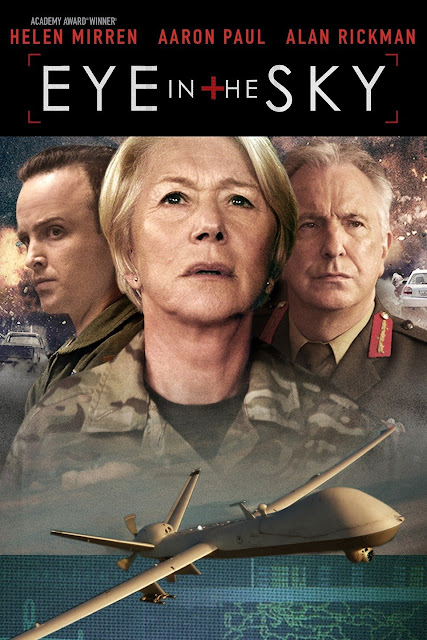
Eye in the Sky (2015)


Eye in the Sky is a 2015 war thriller starring Helen Miran, Alan Rickman, and Aaron Paul.  This was Alan Rickman's last movie before succumbing to pancreatic cancer.

 A military operation uses a Predator UAV to track a group of highly wanted terrorists to a house in Kenya where a couple of suicide bombings are being prepared.  Since the Predator is equipped with a couple of Hellfire missiles, and there is an imminent threat, the logical thing to do is to blow up the house from the air.  

However, there is a problem.  A little girl from the same neighborhood starts selling loaves of bread baked by her mother just outside the house with the terrorists inside.  The conflict of the film is what to do about the little girl?   This is a decision that goes up and down the command chain and gets debated hotly as a moral conundrum.

The movie also uses a couple of micro-drones disguised as animals that may not really exist.  We don't know for sure what secret technology the military may have.

Is this an anti-war film?  Maybe.  But it also debates the morality of fighting a war with drones from thousands of miles away where the participants are safe from the consequences.

The tension in this movie is fantastic.  It also shows how competing political interests might fight over life and death decisions.  Although this is a work of fiction, it is easy to imagine that scenarios like this have played out for real.

Rating:  A

Alien (1979)


The original Alien film from 1979 is a terrific sci-fi horror movie.  The pace is slow, but it builds suspense and has some genuinely scary moments.  

Rating: A

I like the sequel, Aliens, even better for its faster pace.


The scene is iconic and important to the movie. It also goes by quickly. The film quickly switches from relaxed and sexual to sheer terror as Ripley is surprised by the alien monster. Ripley in her underwear feels more vulnerable, but she finds a way to fight back demonstrating that she is a strong character.

Children of Men (2006)


In a bleak chaotic future in which humans can no longer procreate, a government civil servant, Theo, agrees to help transport a miraculously pregnant woman to sanctuary.  Initially she is traveling with a violent rebel group that wants to use the baby to promote their cause.  This group has no qualms about killing anyone who might get in their way, and eventually the group starts an armed rebellion against the British government.

Initially, the film presents us with a dystopian future which is depressing to look at.  This might serve as a warning of things to come.  We can only hope that the future is better than what is depicted in this movie.  However, when the bullets start to fly and the main characters try to escape a war zone, the movie turns intensely violent in a brilliantly executed extended action sequence.

Michael Caine has a strong supporting role as an old hippie, which is counter to his usual roles, but completely believable.

The movie does a great job of exploring post 9-11 themes, as well as religious themes.  The pregnant woman is essentially the mother of the entire future human race.

I had to turn on closed captioning to understand some of the British accents.  The movie never slows down to explain anything, but assumes that you are smart enough to follow along.  I paused the film in places to read some of the billboards, many of which give interesting insights into this future world.

Rating:  A

The movie is rated R for violence, language, and brief nudity.

Star Trek (2008)


I just watched Star Trek for the fourth time.  The first two times were in the theater.  I enjoyed the movie better on video only because some later action scenes were too loud in the theater.

In case you are not aware, Star Trek is the "reboot" of the old TV series and movies into a new series of movies.  It follows the adventures of the old Star Trek characters when they were younger.  In this particular series, the "reboot" happens when Romulins travel back in time and change the course of history resulting in the death of Captain Kirk's father.  In this timeline, Kirk grows up without a father and is more of a miscreant.  A series of events propel him into Starfleet and ultimately toward leadership.  Along the way he has encounters and run-ins with other Star Trek characters, most noticeably a young Spock which the young Kirk doesn't like very much.

This is nearly a perfect movie.  The execution from start to finish is brilliant.  Every scene and every piece of dialog serves to propel the story along at a light speed.  The opening shot is a slightly surrealistic fly-by of a Star Fleet ship cleverly letting us know that reality has changed; This is not your Daddy's Star Trek.  It is cooler looking and more action packed, and more fun.  The movie takes liberties with the Star Trek characters, but these liberties make sense and fit well in the context of the story.

Rating: A

The Impossible (2012)

The Impossible is an inspirational movie about the courage of a family struggling to survive the aftermath of the 2004 Indian Ocean tsunami in Thailand, based on real events.  What I liked about the film is that the family members faced a terrible ordeal with courage, and when possible, helped others.

Rating: A

Attack the Block (2011)


I would rather not give away what "Attack the Block" is about, except that it is aptly described by the movie poster as "INNER CITY VS OUTER SPACE".  What that doesn't tell you is what a great action picture this is, and how great the characters are.  At times it is scary, occasionally funny, but overall it is exciting with some good social commentary thrown in.

Rating:  A

If you don't mind spoilers, check out the trailer:

American Sniper (2014)

The world as we know it today is an unstable place.  There are people whose interests are completely contrarian to our own:  Their beliefs are irreconcilable with ours.  The events of 9-11 showed beyond any doubt that there are people who want to hurt us.  As long as this situation continues, there will be war of one sort or another.  International politics and the war on terror are complex with no easy solutions.  Our role in combating terror has been controversial, as some people have wondered if we really needed to go to Iraq?  Regardless, we went there and put our soldiers in harm's way to fight a fight that we thought was worth fighting. 

Our soldiers are from an all-volunteer military.  These people chose to be soldiers.  Some of these people didn't come back.  Some came back damaged, physically or mentally.  There is another word for people like this:  Heroes.  So it seems extremely appropriate that a movie should be made about one of these heroes, Chris Kyle, who was the most lethal sniper in U.S. military history.  The movie is based upon his book, American Sniper, and is directed by the 84-year-old Clint Eastwood.

This movie is much more than just an intense well acted dramatic biography of Chris Kyle.  It is the story of all who fought.  It is also, in part, our story.  We as a nation have suffered from the terrible attacks of 9-11.  We as a nation chose to fight and endure the consequences of the wars that followed.  Chris Kyle was a perfect reflection of the values of the America that he came from.  He was also a man of deep conviction.  Heroes always are.

Rating:  A

Fury (2014)


Tank veteran Bill Batts thinks that the movie Fury is very authentic, but can't show the full horror of war.  Really?  Fury is about the most horrific war movie I have ever seen.  The war violence is intense.  The last quarter of the film is one very long battle.  Watching the film is a deeply visceral experience.  Maybe this is why many critics didn't praise the film; some have criticized it for glorifying war and violence.

Fury follows a five-man tank crew as the Allies made the final push into Germany.  The tank is commanded by a battled hardened staff sergeant, Don "Wardaddy" Collier, played brilliantly by Brad Pitt.  Much of the movie centers around the relationship between Wardaddy and a very green new recruit, Norman, who isn't quite ready yet to face the horrors of war.

It seems to me that the movie has a political agenda where it portrays American soldiers in an unfavorable light.  Few in this film have any regard for morality, even as they quote scripture and talk about salvation.  In two scenes, soldiers execute an unarmed prisoner.  Maybe one of the prisoners had it coming.  The other soldiers regard these murders as amusing.  They also take sadistic delight in seeing the enemy burn alive.  In another scene, Wardaddy and Norman break into an apartment where two young German ladies are living.  Wardaddy gives the girls some food and they share a meal together, but there is an obvious tension in the room:  There is the implied expectation that one of the girls will have to have sex, willing or not.  The younger of the two ladies falls for Norman and they walk off to the bedroom together.  Everything is casual and amicable until the rest of the tank crew barge in.  The remaining crew are boorish, frighten the ladies and ruin the most peaceful moment of the movie.  Some critics called this the best part of the movie, perhaps because they also have a negative impression of American soldiers, but this particular moment in the film I found grating.

This negative portrayal of American soldiers I don't think is realistic.  There may be a few bad apples, but American soldiers are well disciplined and professional.  Most have a strong sense of morality, if not compassion.

On my second viewing of Fury, everything made sense.  The bad behavior seems insignificant against the backdrop of mass human slaughter that the movie presents to us.  I felt like I was watching history, accurate or not.  At the very least the movie is an interesting history lesson about tank warfare.

Brad Pitt's performance as Wardaddy, as I said, is brilliant, but also very macho.  I think that this is why some people weren't happy with the film.

In the 1940's war movie Sahara, a tank crew decides to make a stand against impossible odds.  The same thing happens in Fury.  I don't think that the crew would have made this decision knowing that they certainly would be killed.  As Tank veteran Bill Batts points out, it is unrealistic to think that they could hold out against a Battalion of  Waffen SS troops.  However, it made for a great final act.

In the final shot of Cool Hand Luke, an aerial view of a cross-shaped intersection is shown as a way of letting the audience know that someone died.  The final shot of Fury copies this technique.

Did I mention that watching the movie is a deeply visceral experience?  The young green recruit, Norman, is so affected by the horrors of war that he becomes a very different person in just a couple of days.  The audience feels this change and identifies with it.

Rating: A

If you can get past the unpleasant subject matter, this is a very brilliant movie.  Fury has a 77% rating on Rotten Tomatoes.

Ender's Game (2013)


Ender's Game is a military science fiction movie based upon a wonderful novella of the same name.  Sometime in the future, the human race is attacked by an alien race called the Formics and the humans barely repel the attack.  In a desperate attempt to prevent another attack, the humans plan to take the battle to the Formic home world.   In the hope of developing new, brilliant leadership, the military begins training a few talented children chosen for space combat.  They go through a series of training simulations, i.e. "games" to prepare them for war.  Ender Wiggin is a particularly brilliant cadet who is taken under the wing of the fanatical Colonel Highland Graf, played by Harrison Ford.  I like Harrison Ford's portrayal of Graf as a man who has only one purpose in life:  Destroy the enemy.

Watching Ender's Game is a deeply visceral experience.  I had my doubts about whether this novella could be adapted to the big screen, but the movie felt intense to me.  I am wondering if the movie will have the same effect on a smaller screen, i.e. Home video?  Maybe one of the reasons the movie felt so intense to me is that I knew what the surprise ending was from having read the book.  The movie and the book raise a few moral questions about the possible genocide of an alien race. 

I highly enjoyed Ender's Game and felt that it was loyal to the book, which, by the way, is one of the best books I ever read.  The book has spawned many sequels, so maybe we will see more of Ender Wiggin on the big screen.

Some of the events in the book are abbreviated or omitted in the movie, including not telling us that Ender unintentionally kills one of the other cadets.

It took me at least an hour after I saw the movie to realize that Ender's sister is played by Abigail Breslin.  It bugs me that I missed this at first.  The pretty little girl from  The Ultimate Gift, Zombie Land, and Little Miss Sunshine has grown into a pretty teenager.

Rating: A

Dawn of the Planet of the Apes (2014)


Dawn of the Planet of the Apes is the worthy sequel to Rise of the Planet of the Apes.  Both are surprisingly great dramas, but the second film is also a really good action film.

After the fall of humanity due to a man-made virus designed to cure Alzheimer's Disease, the apes made intelligent by the virus have settled into the forest area north of San Francisco.  The apes believe that the humans have died out, but a few surviving humans have a small community in San Francisco.  When a couple of humans accidentally encounter the apes, they become frightened and shoot one of the apes, which leads to escalating tensions.  Hotheads on both sides push the two groups toward war.  A few individuals on both sides want to broker a peace, but the hotheads prevail.

The computer generated apes are amazing to look at.  My only complaint is that the apes facial expressions seem a little too human.

It seems obvious that the movie is an analogy for any human conflict.  The conflict started because the humans wanted to restart a hydroelectric dam, i.e. the war starts over energy, or more generally, over resources.  The movie shows how conflict develops from fear of  "the other" or "outsiders".  The fact that the two groups are so different is what helps drive them to war.  This gives the movie a certain noble message that stays with you for a long time.  It feels like an anti-war film that delivers its message better and more subtly than any human versus human conflict could.

This is filmmaking, science fiction and special effects at its best.  

Dawn of the Planet of the Apes has a 90% rating on Rotten Tomatoes.

Richard Roeper gives the movie an "A".

Rating:  A

Wall-E (2008)


I watched Wall-E for the third time since it came out in 2008. This is a truly satisfying movie. It starts like a silent film, with only a few rare unintelligible utterances by Wall-E. He meets another robot named EVE who only utters a couple of words. Wall-E falls in love with EVE, but EVE was sent by humans on a distant spaceship to discover if the long-abandoned Earth could support life again. Together, the pair end up saving the human race.

Rating: A

Steve Jobs (2015)

The news article Basically, nobody went to see the new Steve Jobs movie seems prophetic because I was the only person in the theater watching the movie.  

This is an amazing biopic, but at first I couldn't figure out why I like the movie so much.   The film is about 98% conversation, almost all of which is people arguing with each other.   What makes the film interesting is that everything proceeds at a rapid pace, which means the audience is forced to pay attention to keep up.  When the film was done, I felt like I had just seen something wonderful, but I wasn't sure why.

I doubt that any of the conversations in this film took place exactly as depicted in the movie, but the conversations serve a purpose to convey a great deal of information about people and historical events.

The movie throws technical terms around that would go over the heads of most people, but for a computer hacker like me, this was gravy.  There is a certain joy in being able to understand all of this.

Really the movie is about relationships, specifically how Steve Jobs related to everyone else.   The way Steve Jobs related to everyone is to be a jerk, mostly by lashing out at people, but at the same time, he seemed to draw everyone toward him with the power of his personality and his vision.   Steve Jobs seemed like a man who thought that he was so far above everybody else that he didn't need to take time to be nice to people, so the key is to realize that the only thing he only cared about was is make his vision a reality.  Had Steve Jobs been any different, would the world be a lesser place today?

Steve Jobs vision was always ahead of the technology of the day.   All the early computers his companies created were underpowered, lacking in memory, not very useful for anything productive, and way overpriced.  This is why the Macintosh and the NeXT computers were commercial failures.   It wasn't until Jobs returned to Apple in 1997 that the cost of technology had come down enough to make Jobs' vision a runaway commercial success.

This is one of the best movies of the year and nobody is watching it.   However, this is an amazing movie.  I want to see it again.

Rating: A

Steve Jobs has an 85% rating on Rotten Tomatoes.

Son of Saul (2015)


Sonderkommando were Jews who were forced to work in the Nazi extermination camps.  Their primary duty was to dispose of the bodies.  In 1944, a group of Sonderkommando staged a violent revolt at Auschwitz that was put down by the Nazis.  The Hungarian film Son of Saul takes place during these events.

The movie opens with trainload of Jews arriving at Auschwitz and then being immediately sent to the extermination chambers. Against his will, Saul helps in every part of this process. The movie makes it clear that any Sonderkommando who does not do what he is told is immediately executed. Saul seems to have shut down all his emotions as a way of surviving the horror that surrounds him. Then he recognizes a boy who is killed as his illegitimate son. From this point he makes it his personal mission to get a proper Jewish burial for his son. He hides the body, and then searches desperately for a Rabbi to perform the ceremony.

This is a unique film that doesn't feel like anything I have seen before.  The movie tells a very personal story.  The camera almost never leaves Saul.  Much of the film seems to take place in real time.  We spend half of the film looking at the back of Saul's head as he moves from place to place.  As Saul moves around the camp, we witness one horror after another, most of which are in the periphery, or barely offscreen.  Things happen that are never explained.  There is a mild sense of chaos everywhere in this story.  

I find the subject matter depressing, but not the movie.  The story creates a kind of suspense as Saul tries to find a way to bury his son, and as the revolt builds to fruition.  The film gives us a different perspective on the Holocaust, and it is intensely personal.  Many people would not be able to watch Son of Saul because the Holocaust is too horrible to contemplate, but this feels like a story worth watching.

Rating:  A