Movies
Sunday, December 7, 2025
1917
Contagion
I rewatched "Contagion" after seeing it in the theater when it came out in 2011.
I have never seen a more prophetic movie in my entire life. At least 80% of the film seems applicable to the current COVID-19 pandemic. The biggest difference is the deadliness of the disease, which instead of being about 2% for known cases is around 25%. But detail after detail comes up that I only recently learned about during the COVID crisis.
The movie has an 85% rating on Rotten Tomatoes, although not all the critics were equally enthusiastic. The audience score is only 63%, so I suspect that the subject matter might have turned off some people. Rotten Tomatoes describes it as, "Tense, tightly plotted, and bolstered by a stellar cast. Contagion is an exceptionally smart -- and scary -- disaster movie." I agree. It tells a fantastic story. My favorite movie critic, Richard Roeper, gives it 5 out of 5 stating, "Contagion" is a brilliantly executed disease outbreak movie."
Rating: A+.
The Wild Robot
I have one big complaint about a plot point that doesn't make sense and is likely there to push an agenda. The robot is on an island with animals that normally compete with and kill each other. While the animals are hibernating for the winter, a massive snowstorm threatens life on the island. The robot takes it upon itself to bring some of the hibernating animals to a large shelter that it has built. While in the shelter the animals agree to overcome their natural instincts and cooperate for their mutual survival.
Rouge One: A Star Wars Story
Rogue One is surprisingly beautiful. We see shots of planets that are stunning in their detail and beauty, plus everything else in the movie looks gorgeous. Movies like this are an incredible technical achievement. A generation ago, a movie that looked this amazing would have blown audiences away, even if the story was terrible, which fortunately, it isn't.
I am revising my rating of the film from "B+" to "A-".
Oppenheimer
The Vast of the Night
When I was reviewing the movie "The Signal", I said that the trouble with low budget science fiction movies is that these types of films might have one good idea, whereas a big-budget movie like "Star Wars: The Empire Strikes Back" is loaded with many good ideas. The Signal kept you in suspense for the whole film, making you think that this story was leading up to something wonderful. There was a payoff in the end, but that payoff was so short that if you had closed your eyes for just a couple of seconds then you would have missed it. Literally. Everything I said about "The Signal" is also true for "The Vast of the Night", except the ending is a little longer. However, both movies are an exercise in prolonged tension to arrive at similar endings. The Vast of the Night feels like a master class in low budget filmmaking. It does a great job with its long camera shots and its unknown actors who give stellar performances. The movie starts by showing an old fashioned television screen like it is playing an episode of the old Twilight Zone. The camera zooms into the screen and now we are following characters in a 1950's small New Mexico town on the night of a high school basketball game. It spends a long 20 minutes introducing its settings and characters, after which the local switchboard operator starts noticing weird things happening. She teams up with her friend, a disk jockey at a one-man radio station to investigate what is going on. Many of the scenes drag on a bit, mostly with conversation. But there is a frantic tension that builds toward the conclusion. Fortunately, the actors really sell this story. We get a sense that these are ordinary people caught up in something big that they don't understand. The minimalist style of this film could be called experimental, but for 85 minutes it works really well. Rating: B+. A reviewer on youtube gave the film an A-. https://www.youtube.com/watch?v=_HEcnacyI_8
Thor Love and Thunder
Lightyear
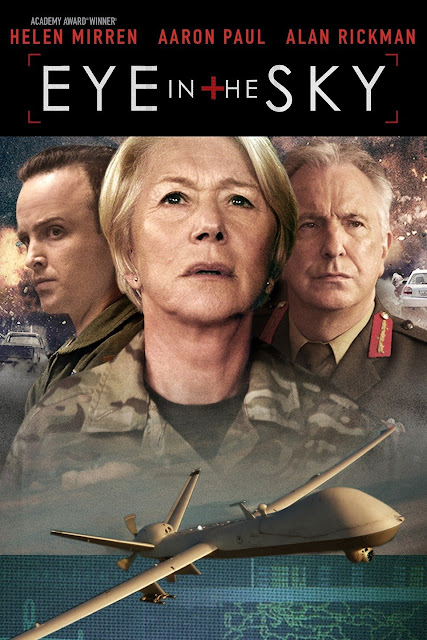
Eye in the Sky
A military operation uses a Predator UAV to track a group of highly wanted terrorists to a house in Kenya where a couple of suicide bombings are being prepared. Since the Predator is equipped with a couple of Hellfire missiles, and there is an imminent threat, the logical thing to do is to blow up the house from the air.
However, there is a problem. A little girl from the same neighborhood starts selling loaves of bread baked by her mother just outside the house with the terrorists inside. The conflict of the film is what to do about the little girl? This is a decision that goes up and down the command chain and gets debated hotly as a moral conundrum.
The movie also uses a couple of micro-drones disguised as animals that may not really exist. We don't know for sure what secret technology the military may have.
Is this an anti-war film? Maybe. But it also debates the morality of fighting a war with drones from thousands of miles away where the participants are safe from the consequences.
The tension in this movie is fantastic. It also shows how competing political interests might fight over life and death decisions. Although this is a work of fiction, it is easy to imagine that scenarios like this have played out for real.
Rating: A.
HBO's Chernobyl
Normally I would find these kinds of mistakes unforgivable, but Chernobyl also gets a great many facts right, not the least of which is the human suffering of a terrible nuclear accident. Some scenes might be too graphic for people. Chernobyl does not shy away from the more unpleasant aspects of this disaster.
Early on in the miniseries, many of the nuclear workers and scientists can't fathom how such an accident could happen. The show keeps us in suspense by saving the explanation for last. It was a combination of bad design and poor training leading to incompetent nuclear workers.
Alien Earth Season 1
Superman The Movie and Superman II
Superman The Movie came out on December 15th, 1978. It was fairly impressive for its time. This was just a year and a half after the original Star Wars, and the special effects were groundbreaking. It was one thing to have ships flying through space, it is another to have a person fly through the air and look believable. At the Oscars, the film solely won the Special Achievement Award for Visual Effects.
What I didn't remember about this film is that it is half comedy, showing its comic book roots. It doesn't take itself seriously, unlike the more recent Superman Returns and Man of Steel. The film's goofiness is distracting, but this seemed normal in 1978. We were used to campy superheroes, having watched Batman on television in the 1960s.
Some Superman fanatics didn't like Man of Steel because that movie ditched the red tights. I think that the red tights look goofy, and in the modern era, I prefer more serious superheroes.
Christopher Reeve was a great actor and he feels like he was born to play Superman. He is completely believable in the role, and he does a great job as his alter ego mild-mannered reporter Clark Kent.
Whatever problems Margo Kidder had later in life, she made a great Louis Lane.
There are only two memorable pieces of music but they are fantastic. The score by John Williams practically makes the film. Even Christopher Reeve acknowledged this and said that Superman would not be able to fly without John Williams's music. The Superman Theme is rousing and is used constantly. The love song "Can You Read My Mind" is Oscar-worthy, and notes from this song are snuck into almost every scene with Louis Lane.
Superman
After the opening weekend of Tim Burton’s 2001 remake of Planet of the Apes, I heard a local radio personality say, “This weekend I went to see a movie. There were apes in it. That’s good enough for me.” I felt the same way. I went to the theater. I was entertained. That was good enough for me.
But nobody really remembers this version of Planet of the Apes. It has largely been forgotten. Why? Because the movie had no depth. Despite some entertaining action sequences, it felt rather shallow. The characters weren’t particularly interesting or complex, so we had no reason to root for them—or to want to see them in a sequel. It paled in comparison to both the original and the reboot that would follow in 2011.
The 2025 version of Superman is about as emotionally satisfying as a bag of popcorn. The story can be summarized like this: Superman gets beat up a few times by powerful enemies, finds a way to win, saves a few people along the way, and patches up his relationship with Lois Lane. That’s it.
The movie introduces many characters but doesn’t give them enough screen time for us to get to know them.
Superman’s parents are portrayed as loving country folk, but the film doesn’t give us much reason to care about them.
Nicholas Hoult starts out strong as Lex Luthor, but toward the end, his character also feels shallow.
David Corenswet makes a decent Superman. He shows the most emotional depth of any character in the film, but he doesn’t feel as authentic as Christopher Reeve or Henry Cavill, both of whom embodied the character more convincingly, both physically and emotionally.
This movie is all about action, not characters—and that’s a major shortcoming. It tries to do too much, throwing so much at the audience that we’re not supposed to notice the lack of emotional connection. Despite the problems, the movie is somewhat entertaining.
The ending fails to stick the landing. It wraps up with a series of news clips meant to tie everything together, but it feels way too rushed.
I have no desire to see this movie a second time.
Rating: B-
I much prefer Man of Steel, which feels more like a genuine science fiction film than most Superman movies. I even prefer Superman Returns for its character development.
Snow White and the Seven Dwarfs
Disney has released a new version of Snow White and the Seven Dwarfs. The early reviews are not good.
Three days ago I watched the original Snow White and the Seven Dwarfs for the third time in my life. The animation is fantastic, and two of the songs are particularly good. The dwarfs are wonderful. A couple of decades ago, this movie truly captured my heart. It’s easy to love the dwarfs and feel the emotion as they mourn Snow White’s apparent death.
However, the story is quite lightweight, and much of the film feels like filler. Nearly half of it consists of slapstick comedy. Too much time is spent on exposition, and not all of the music is engaging.
Had I seen this movie in 1937, I would have regarded it as the greatest animated film made up to that point—which it was. It was truly groundbreaking. However, it would be surpassed just three years later by Pinocchio.
Rating: B+.
Superman Returns * * * 1/2
Superman Returns explores the Superman story in a post 9-11 world. After a trip to find his home planet, Superman returns to earth to find that Lois Lane is married and has a child. It is a world that has mostly forgotten about superheroes.
The Creator
Some of the robots aren't that different from human beings. They feel and possibly suffer, and mourn each other when they die.
Sergeant Joshua Taylor is sent on a mission to capture a new AI weapon, and this weapon turns out to be in the form of a little girl. Taylor begins to bond with it and he is also on a side quest to find his wife behind enemy lines and uses the "girl" to help find her. This creates a conflict with his commanding officer who is a little too gung-ho about killing robots. She is trying to hunt down both Taylor and the girl.
This movie has shades of Blade Runner and the film A.I. Artificial Intelligence. Both movies make you question what it means to be human and if a machine can have human qualities. The ending is reminiscent of Elysium.
The film shows the suffering, destruction, and utter pointlessness of war, which is emotionally powerful for the audience.
The Creator received positive but mixed reviews. Some criticized the overall tone and the complexity of the story. However, the movie was made on a shoestring 80 million dollar budget, and it deserves credit for looking gorgeous, like a much bigger budget production. It is visually impressive and unique.
This is an epic story that I think will age very well. It could be remembered alongside Blade Runner. However, the movie's ideas are better than their execution, and the complicated story feels a bit messy.
Rating B+.
The Creator is available for streaming on Disney+ and Hulu.
Man of Steel
I wrote of review of Man of Steel right after it came out. I simply noted that I liked it much better than the average review on Rotten Tomatoes. I am a sucker for Superman stories. I very much liked the slightly mundane Superman Returns, and I was a big fan of the television show Smallville until it overstayed its welcome by stretching out to ten seasons.
I cringed in just a few places where the dialog seemed simplistic or just unnecessary. Movies have a compulsion to explain what is going on in the simplest possible terms just to make sure that we get it.
Reagan
Batman Vs. Superman
I can see why Batman vs. Superman got mostly negative reviews. The movie is overloaded with action sequences and drags out too long. But the film is underrated. Between all those action sequences are bits of dialog, so brief that you have to pay attention to keep up, that are gold. Jesse Eisenberg steals the show as Lex Luther. He is a welcome surprise, playing a really manic Luther with some cool dialog.
https://www.rottentomatoes.com/m/batman_v_superman_dawn_of_justiceIndiana Jones and the Dial of Destiny
The Imitation Game
I wish that I could say that "The Imitation Game" is objectively a bad movie. The problem is that it is very entertaining, but it is one of the most historically inaccurate films I have seen in recent memory. I was already familiar with the history of breaking the Nazi Enigma code, so on my first viewing, I noticed a problem with the scene where the code breakers decide to not stop a German attack for fear of alerting the Nazis that they had broken the code. In reality, these decisions were made at the highest level of the government of Great Britain.
However, on my second viewing, I noticed how the movie is loaded with melodramatic scenes, and I guessed that every one of these scenes is either a complete fiction or a big distortion of actual events. It turns out that I was right. The film also leaves out a great deal of actual history giving the viewer the false impression that Turring was solely responsible for breaking the code.
I have a low tolerance for movies that distort history, and it is a problem we see in many films. Why should I care so much? Because it miseducates the public about real events.
https://screenrant.com/imitation-game-true-story-every-change/
The Remains of the Day
The movie "The Remains of the Day" came out 31 years ago. I am often surprised by the passage of time. Anthony Hopkins was 55 years old when it came out, and this was two years after he did "The Silence of the Lambs."
The movie was highly praised for its performances and for its message. Anthony Hopkins was nominated for Best Actor. The main character is effectively in a prison partially of his own making by being stuck in English tradition and roles.
I remember thinking that the movie was a bit of a bore and a waste of Emma Thompson. It was delightful to see Christopher Reeve in a small role at the end.
Nope
Nope is a science fiction horror film. It is available on Amazon Prime.
A brother and sister struggle to run a Hollywood horse-training farm after the death of their father (Keith David from Cloud Atlas.) Meanwhile, their neighbor (Steven Yeun from The Walking Dead) is running a nearby Western and UFO themed mini amusement park tourist trap. They all begin to suspect that something alien and dangerous is moving around in the clouds. The story plays out like a science fiction version of Jaws.
The film makes good use of sound. We hear faint sounds in the distance that might be screaming.
The movie has a huge plot hole because the characters suspect that something in the clouds is killing people, but they don't try to contact the authorities. Instead, they want to film this danger so that they can make money and become famous. Had they contacted the police and successfully made their case, the issue would have escalated up the hierarchy until it eventually provoked a military response.
The movie starts with a truly bizarre scene where a young version of the Steven Yeun character is playing in a '90s sitcom. A trained chimpanzee on the show goes berserk and kills most of the people on the set. This is not far-fetched, since chimpanzees are extremely aggressive and violent. At first, it is hard to understand why this scene is in the movie, but the film later tries to make the point that trained wild animals can still be dangerous, and this just might have something to do with whatever it is in the clouds.
I have often said that cheap science fiction typically will have only one good idea, and those movies stretch their one good idea out for 90 minutes, or in the case of this film, 2 hours. The story is rather clever, but the pace of the film is a bit too slow. Fortunately, unlike most films of this genre, they don't wait till the end of the movie for the big reveal. We get the big reveal halfway through, and the remainder of the film is about the characters responding to it. As such, the film is more exciting than films like The Vast of the Night, The Signal, Monsters, and Annihilation. Even though these movies were entertaining, nobody cares about them anymore because their lack of substance made them forgettable.
Despite the rather slow pace, especially in the first half which spends much time building up the story, Nope made me care about these characters enough to keep me involved.
Rating: B-.
Guardians of the Galaxy Volume 3
Guardians of the Galaxy Volume 3, available for streaming on Disney+, is the best of the Guardians of the Galaxy movies. Unfortunately, it is the last since James Gunn has given an emphatic "No!" to any more sequels. These movies are entertaining enough that I don't see why they can't continue indefinitely, and I really want to see more of these characters. (Never say never again.)
The film is a bit limited by being a live-action comic book dominated by action scenes, but it has the most character development, centering around the life and backstory of Rocket Racoon. We get his origin story, along with the villainous character who created him. Some movies are only as good as their villain, which isn't entirely true here. Rocket was created by "The Great Geneticist", who has a god complex and considers Rocket to be his property. As far as villains go, "The Great Geneticist" feels rather routine.
Near the end of the movie, all the characters having gone through an ordeal, embrace each other. It would have been poignant and brilliant if the movie had ended at this moment. Some fans might have felt shortchanged and complained. Instead, the film gives us several more minutes designed to make us feel happy, but the actual ending is pretty fluffy and insubstantial.
There are a couple of scenes in the credits which promise the return of "Star-Lord", which means the Chris Pratt character will turn up someday in a different Marvel movie.
This film is a fun ride, so I only hope that eventually, we will get a sequel.
Rating: A-.
Star Wars in a historical context
We were going through the worst economic decade of my lifetime. Some people might look at the events that followed 2008 as being the worst, but the American economy was much more robust in 2008 and able to eventually rebound. However, the 1970s were just one piece of bad news after another. The country felt like it was in a giant malaise.
Then came Star Wars in 1977, which to my 17-year-old mind felt like a godsend. It was a metaphor for a hopeful battle against all the evils that plagued us.
Star Wars became an important part of my life, and it influenced my career toward computers and video game development. To this day, Star Wars feels like a part of my personality.
At my more advanced age of 63, I notice how violent Star Wars is. This didn't seem like much of an issue in 1977 when the characters were fighting Space Nazis, because the 1970s felt like an existential struggle against the forces of evil. For example, Star Wars calls light sabers an elegant weapon, but how elegant is cutting people in half or cutting their heads off? It would be like calling a battle axe an elegant weapon.
All this makes me wonder how relevant Star Wars is to our current time? The 20th century was by far the most violent in history, which made mechanized murder on a mass scale feel more normal. I think that there was less regard for the individual, which is something we take to extreme levels today.
I feel far less threatened by outside forces today than I did after 9-11, or in the 60s, the 70s, and the 80s.
We can still fantasize about a struggle for survival between good and evil, but good and evil in the modern world are less distinct from one another.
This makes me think that Star Wars has to change to remain relevant. The original movie gave us 1970s characters in a futuristic setting. The recent series Andor did a great job of giving us modern characters in the same setting and feels more relevant to the time we live in.
--
Best wishes,
John Coffey
http://www.entertainmentjourney.com
The Empire Strikes Back
All of the OT's successes originated from George Lucas. Did you know that the first cut of 'The Empire Strikes Back' was a disaster? Here's what a now deleted article from ScreenRant says, titled '15 Things You Never Knew About The Empire Strikes Back'. Fact #7 was that, you guessed it, "The First Cut Was A Disaster, Requiring Heavy Reshoots". The article then goes on to say "With shooting way behind schedule and costs running out of control on The Empire Strikes Back , George Lucas started to panic. With his entire personal fortune invested in production on Empire , the failure of the movie would mean persona and professional ruin. Shooting wrapped, and Lucas breathed a sigh of relief". That's good, you might say. However, the article continues with: "Then came the disastrous rough cut, which left Marcia Lucas in tears. Lucas exploded, furious with Gary Kurtz and Irvin Kershner at having spent his personal fortune to make a bad movie. Lucas tried reediting the movie himself to no avail. He then decided to film extensive reshoots, reworking the Han/Leia love subplot. That raised the cost of the picture even more, as Lucas had to divert funds from construction of Skywalker Ranch to keep the movie shooting. He also had to approach Fox for a loan, which production executive Alan Ladd, Jr. helped him secure. Ladd would later quit Fox over the loan, when Empire became a runaway hit